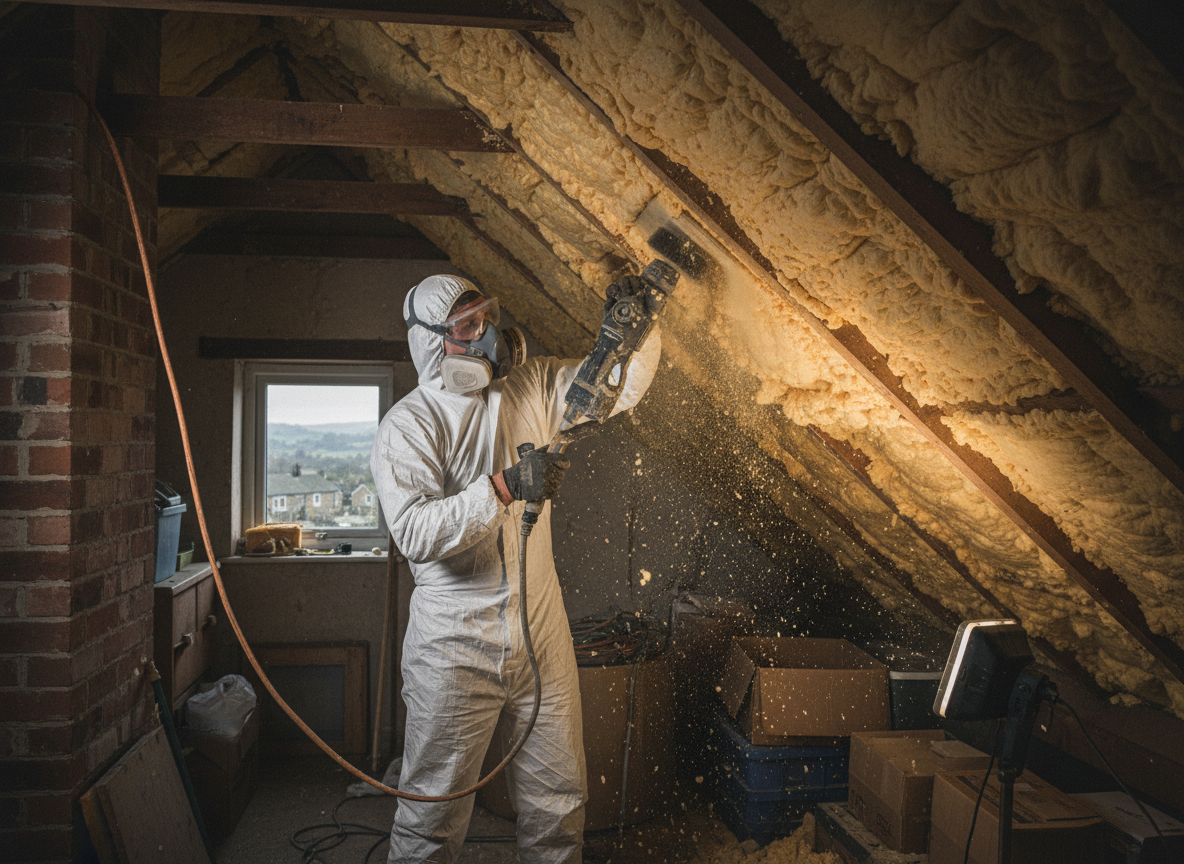
Thermal spray foam removal in Huddersfield often involves older terraced housing stock from the Victorian and Edwardian eras common across West Yorkshire. These properties frequently have irregular stone or brick substrates where closed-cell foam adheres aggressively, especially in roof voids and wall cavities. Removal requires controlled mechanical scraping combined with solvent softening to prevent substrate damage while containing dust and off-gassing. Homeowners in areas like Marsh, Paddock and Lindley regularly encounter this when retrofitted insulation fails or needs replacement for building regulation compliance.
Edge cases arise during wet West Yorkshire winters when moisture trapped behind foam leads to timber rot in rafters. Technicians must first isolate affected sections, then use negative-pressure extraction to pull material without spreading particulates into living spaces. Disposal follows Environment Agency rules for polyurethane waste, with loads taken to licensed sites rather than general landfill. Attempting DIY removal risks respiratory irritation from isocyanates and incomplete extraction that leaves residue affecting future insulation performance.
Code considerations include checking that removal does not compromise fire compartmentation in mid-terrace homes typical of Huddersfield. Proper sequencing starts with access creation, followed by layer-by-layer extraction, substrate cleaning and ventilation restoration. Properties near the canal basin or on sloped terrain around Almondbury can present additional access challenges due to limited roof space and shared party walls.
Technician insight
In Huddersfield, the thing that catches most people out with thermal spray foam removal is how tightly the foam bonds to the irregular stone walls in 19th-century terraces around Paddock and Marsh. Homeowners often underestimate the extra time needed for careful scraping to avoid crumbling the substrate during damp winters.
Foam Removal in Lindley Terrace
Homeowner reported musty smells and poor loft insulation performance in a stone-built Lindley terrace. Inspection revealed closed-cell foam trapping moisture against rafters. We set up containment, extracted the foam layer by layer, cleaned the substrate and disposed of waste. The void was left ready for proper ventilation and new insulation.
How it works
- 1
Site Assessment
Inspect foam depth, substrate condition and access points in the Huddersfield property.
- 2
Containment Setup
Install negative air machines and sealing to prevent dust migration into occupied areas.
- 3
Material Extraction
Apply solvent softening then mechanical removal in controlled layers.
- 4
Substrate Cleaning
Scrub residues and verify no remaining foam or contaminants.
- 5
Waste Disposal and Verification
Remove waste to licensed facilities and confirm cavity is clear for reinsulation.
Pricing
Cost depends on property size, foam thickness and access difficulty in Huddersfield terraces.