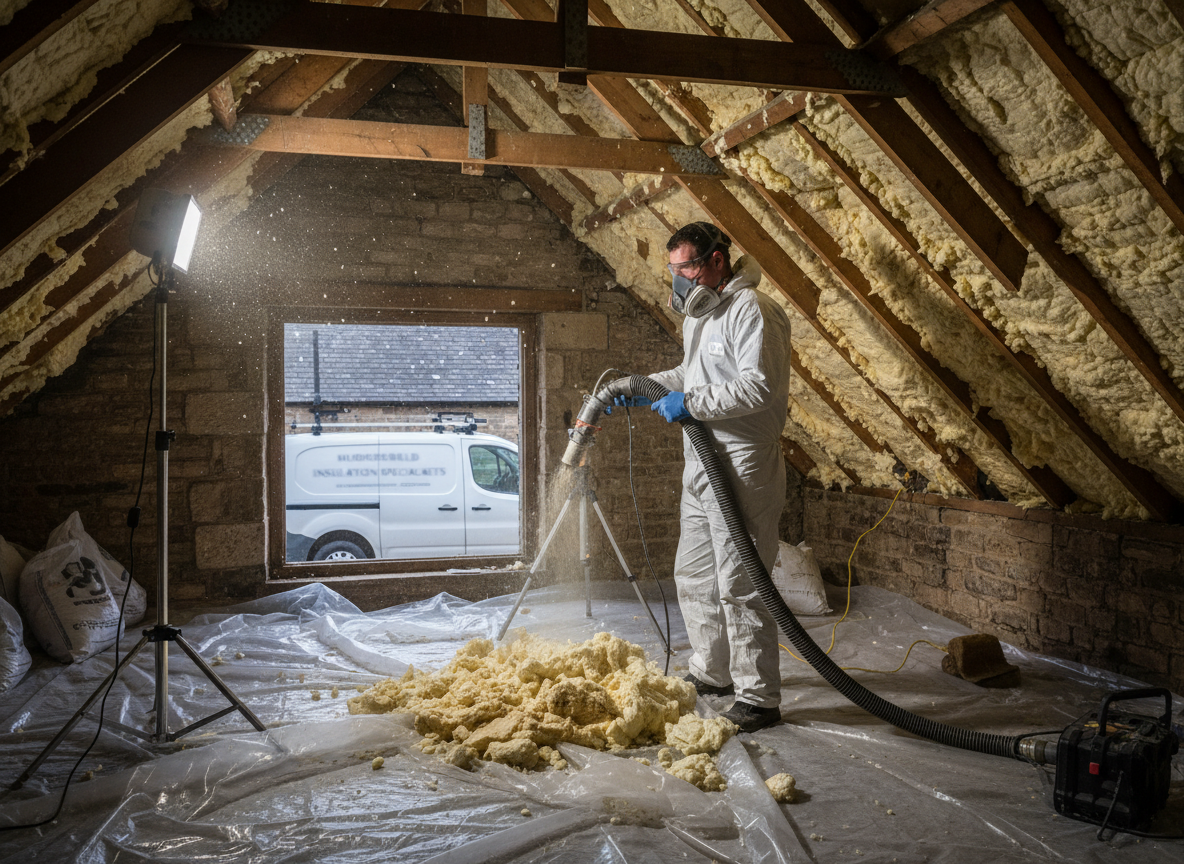
Huddersfield's Victorian and Edwardian terraced housing stock, common in neighborhoods such as Marsh, Lindley and Paddock, frequently received spray foam insulation in lofts during the 2000s. The region's heavy Pennine rainfall and stone-walled construction mean the foam often seals in moisture against original timbers and slates, accelerating rot that only becomes visible once removal begins. Proper extraction requires protecting internal ceilings below while working around narrow loft hatches typical of these properties.
Closed-cell polyurethane bonds tightly to rafters and can release isocyanates during cutting, so full PPE and negative-pressure extraction are essential on every job. In West Yorkshire homes, we routinely find the foam has bridged eaves ventilation, creating hidden condensation zones that affect neighboring properties in terraces. Removal must restore original airflow paths without damaging historic lath and plaster ceilings below.
Local planning rules in the Huddersfield conservation areas around the town centre require careful debris containment so that foam particles do not enter shared chimneys or downpipes. After extraction we inspect for timber decay and advise on breathable insulation replacements suited to the damp climate rather than re-applying foam. Disposal routes must follow Environment Agency guidelines for hazardous waste generated in the region.
Technician insight
In Huddersfield the thing that catches most people out with spray foam insulation removal is how quickly the Pennine damp gets behind the foam into the original rafters of 1890s terraces; once the foam is gone you often find rot that was invisible before, and the job turns from simple extraction into timber repair.
Marsh terrace loft clearance
A homeowner in Marsh reported persistent damp smells after spray foam was installed ten years earlier. Inspection showed closed-cell foam had sealed the eaves on a 1905 pitched roof. We removed the foam, restored ventilation, and treated early rot on two rafters before it spread to adjacent properties.
How it works
- 1
Site Survey and Risk Assessment
We inspect the loft or wall cavities from our Huddersfield base, checking for timber condition, ventilation paths and access constraints typical of local stone terraces.
- 2
Containment and Preparation
Protective sheeting and negative-pressure setups are installed to prevent dust migration into living spaces below, essential in densely packed West Yorkshire terraces.
- 3
Controlled Removal
Foam is cut and extracted in sections using specialist equipment, with constant monitoring for hidden moisture or rot in the original roof structure.
- 4
Ventilation Restoration and Clean-up
Eaves and ridge vents are reopened, debris is removed, and the space is left ready for inspection or alternative insulation.
Pricing
Pricing depends on access difficulty, foam depth and disposal volume in Huddersfield properties.