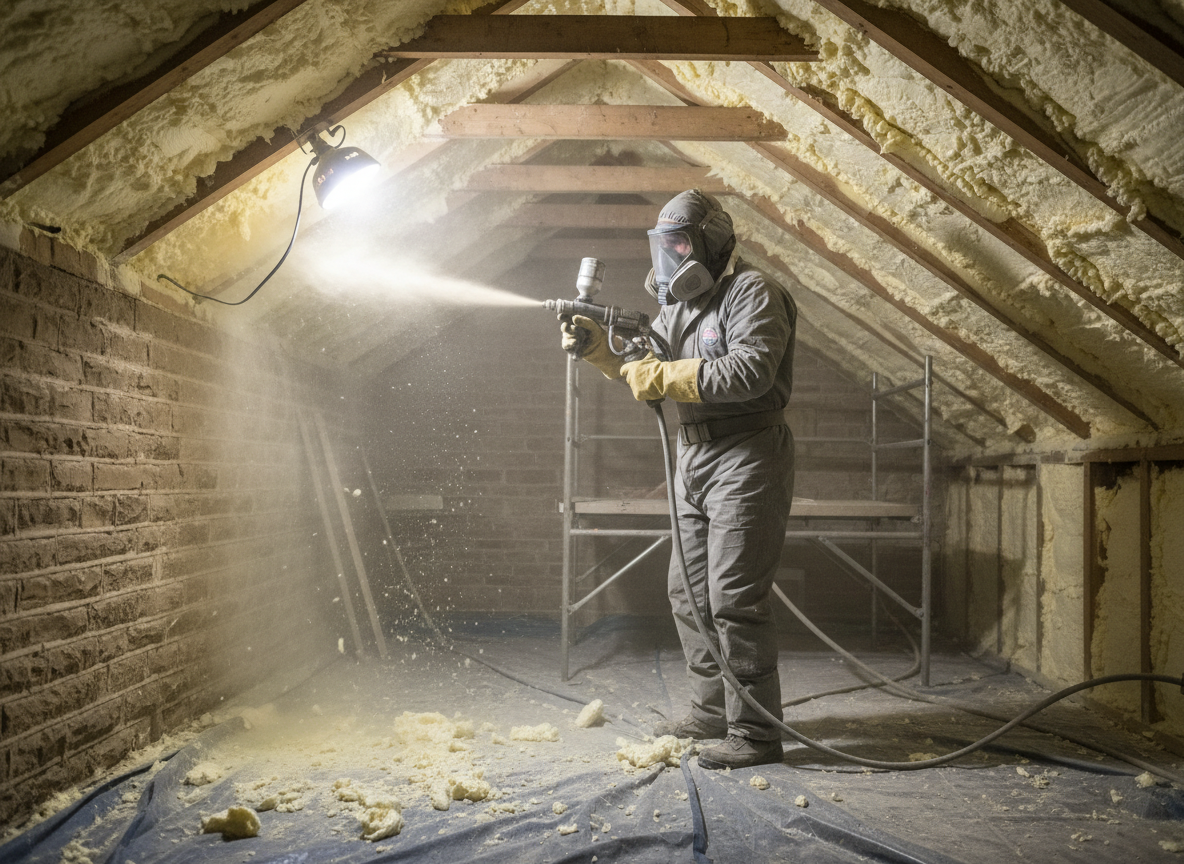
Huddersfield's older terraced and semi-detached housing stock, much of it built before 1950, frequently contains closed-cell spray foam applied to roof voids during energy upgrades in the 2000s. Sand blasting removes this material without the chemical residues left by solvents, which matters in properties where timber joists have absorbed moisture from the region's frequent rainfall. The process uses controlled abrasive media to strip foam from rafters and between ceiling joists while containing silica dust that can otherwise migrate into living spaces below. Access through small loft hatches common in Victorian terraces often requires sectional equipment that fits through standard openings without enlarging them.
West Yorkshire's damp climate accelerates foam degradation, leading to crumbling that releases fibres into ventilation paths. Sand blasting crews working from our Station Street base must seal chimney stacks and party walls in attached homes to prevent cross-contamination between neighbouring properties. Unlike chemical stripping, blasting reaches foam lodged in irregular stone or brickwork found in many HD1 and HD2 postcodes, though it demands temporary propping of ceilings in rooms with lath-and-plaster finishes. Homeowners on sloping streets around the town centre often need extra containment sheeting because wind funnels through the valleys and carries dust.
After blasting, residual dust is vacuumed with HEPA equipment before new insulation or ventilation upgrades are installed. This step prevents the fine particles from settling into electrical fittings, a frequent issue in 1930s semis where wiring runs through the same voids. The method suits listed or conservation-area buildings around Huddersfield where chemical alternatives risk damaging historic timbers. Crews schedule around the wettest months to avoid introducing additional moisture during the containment phase.
Technician insight
In Huddersfield, the thing that catches most people out with sand blasting spray foam insulation removal is the amount of dust that travels through shared chimney flues in Victorian terraces. One missed seal on a party wall and it ends up in the neighbour's bedroom two doors down. The hilly streets around the station also mean extra sheeting because wind picks up the fines before the vacuum can catch them.
Terraced house loft clearance near Huddersfield station
Foam applied fifteen years earlier had begun shedding particles into the bedrooms below. Inspection showed foam bridging the party wall into the next property. Sand blasting removed all material while temporary props protected the lath-and-plaster ceiling. Neighbouring voids were sealed before work started, and the job finished with full dust extraction and clearance certificate.
How it works
- 1
Site Assessment
Inspect loft access, roof structure and neighbouring walls to map foam depth and identify fragile plaster or wiring.
- 2
Containment Setup
Seal rooms below, cover chimney breasts and install negative-pressure dust extraction from the Station Street van.
- 3
Abrasive Removal
Apply calibrated sand-blasting nozzles to strip foam from rafters and between joists without scoring timber.
- 4
Dust Clearance and Final Check
HEPA vacuum all surfaces, inspect for remaining foam pockets and confirm no migration into adjacent properties.
Pricing
Cost depends on loft size, foam thickness and access difficulty in terraced or semi-detached homes; quotes provided after inspection.