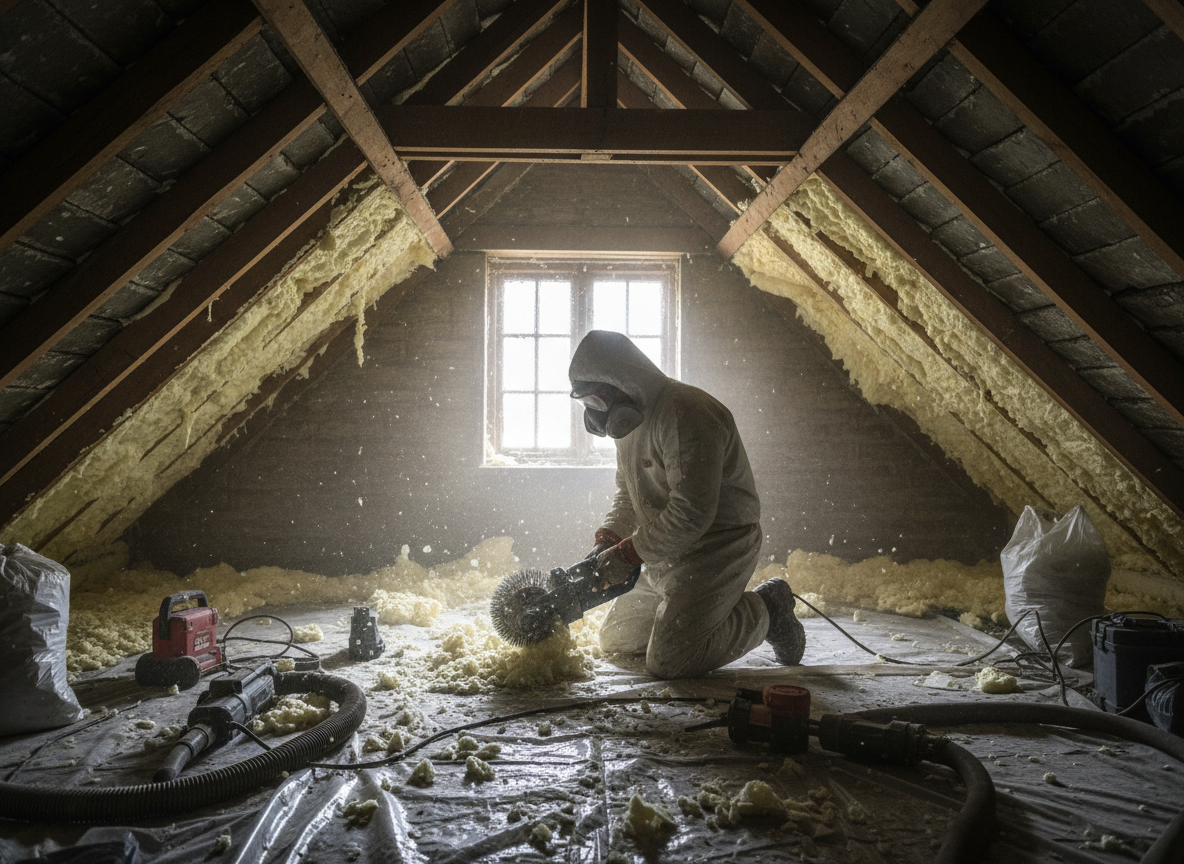
Open cell spray foam was widely installed in Huddersfield lofts during the 2000s and early 2010s, particularly in Victorian terraces around the town centre and areas like Marsh and Paddock. Over time the material absorbs moisture from West Yorkshire's frequent rain and poor loft ventilation, leading to timber decay in rafters and ceilings. Removal requires careful cutting and vacuum extraction to avoid disturbing original lathe and plaster ceilings below, which are common in pre-1919 stock and easily damaged by over-aggressive pulling.
Homeowners in the HD1 and HD2 postcodes often call after noticing musty smells or increased heating bills once the foam starts breaking down. The open cell structure bonds tightly to uneven stone and brickwork found in local mills and back-to-back houses, so mechanical scraping followed by solvent wipes is usually needed on the substrate. We work in small sections to control dust and contain debris, especially important when properties sit close together with shared roof spaces along streets near the railway station.
West Yorkshire Building Regulations now flag open cell foam in older roofs as a ventilation risk, and mortgage surveys frequently require its removal before lending on terraced houses. Extraction must be paired with checks for existing roof felt condition and the addition of proper eaves ventilation once the foam is gone. Our team based at 12 Station St operates 24/7 to handle emergency jobs when water ingress has already started after heavy Pennine storms.
Technician insight
In Huddersfield, the thing that catches most people out with open cell spray foam removal is how quickly moisture from the Pennines gets trapped behind the foam in stone-walled Victorian terraces. Once we start stripping it, you often find the original felt has rotted along the eaves and the rafters need treatment before any new insulation goes back in.
Foam Removal in a Marsh Terrace Loft
A homeowner in a 1890s terrace near Marsh reported persistent damp smells after heavy rain. We found open cell foam had absorbed water through failed eaves and caused rot along three rafters. The foam was cut out in sections, debris vacuumed, and the timber treated before new ventilation was installed.
How it works
- 1
Initial Loft Survey
We inspect the foam depth, roof structure and any signs of damp in Huddersfield properties before quoting.
- 2
Site Protection and Containment
Floors, electrics and neighbouring lofts are sealed off to manage dust and debris during cutting.
- 3
Mechanical Removal
Foam is cut into sections and extracted using industrial vacuums, followed by substrate cleaning.
- 4
Ventilation and Final Check
Eaves vents are verified or added and the space is inspected for remaining residue before handover.
Pricing
Cost depends on loft size, foam thickness and access; we issue a fixed quote after the on-site survey.